
- The Mass Number Of An Atom Is Determined By The Number Of
- The Mass Number Of An Atom Is The Number Of Protons In The Nucleus
20th Jun 2019 @ 13 min read
An atom consists of electrons, protons, and neutrons. Protons and neutrons reside in the nucleus of an atom, and they, in together, are called nucleons. The number of nucleons present in an atom is called mass number. Mass number, as from the name, is responsible for the mass of an atom or atomic mass. Since protons and neutrons are much heavier than electrons, the mass of an atom is estimated by the number of protons and the number of neutrons or in other words, mass number. Mass number is always a whole number because the number of protons and neutrons present in an atom is always a whole number.
Definition
Mass number is the number of nucleons (the sum of protons and neutrons) present in an atom. Mass number is also called as atomic number or nucleon number.
The Mass Number Of An Atom Is Determined By The Number Of
- The atomic number for the element calcium (Ca) is 20. How many protons and electrons does each atom have? An atom has an atomic number of 79 and an atomic mass of 197. Once this atom enters into an ionic bond, it has how many proton, neutrons, and electrons?
- The mass number of an atom is its total number of protons and neutrons. Atoms of different elements usually have different mass numbers, but they can be the same. For example, the mass number of.
What is the mass number of this atom? None of the above. Tags: Question 17. What is the atomic number of this atom? None of the above. Tags: Question 18. What is the mass number of this atom? The mass number of an atom is the total number of protons and neutrons in an atomic nucleus. The mass number is written either after the element name or as a superscript to the left of an element's symbol. For carbon 14, an isotope of carbon, it is written as carbon-12 or 1 2 C.
Notation and Formula
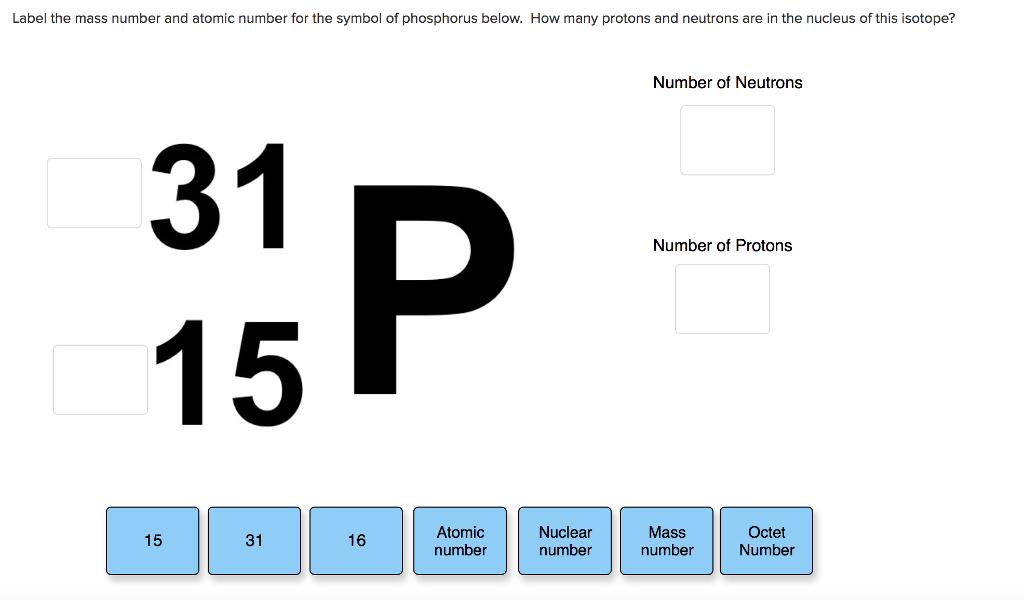
Mass number is denoted as A. The value of A is calculated by summing the number of protons and neutron in the nucleus of an atom.
where: np+ is the number of protons and nn0 is the number of neutrons.
Representation
The mass number is represented as the left superscript to the symbol of an element. Consider an example of sodium, which has a mass number of 23. The number is superscripted to the left of the symbol of sodium, which is Na (see the below figure). When using the full name of an element, not its symbol, mass number come after the name of an element with a hyphen in between, for example, sodium-23, carbon-12, iron-56.
Mass Number and Atomic Number
Mass number and atomic number are often confusing for beginners, but they both are different. The below table distinguishes them.
| Mass Number | Atomic Number |
| Mass number is the number of nucleons (protons and neutrons) present in the nucleus of an atom. | Atomic number is the number of protons present in the nucleus of an atom. |
| It is denoted as A. | It is denoted as Z. |
| It can be different for a given element, for example, an oxygen atom can have mass number of 16, 17, or 18. | It is always fixed for a given element, for example, the atomic number of an oxygen atom is 16. This is true for any oxygen atom in the universe. |
| Two different elements can have the same mass number as in 40 20Ca and 40 18Ar. | Two different elements always have a different atomic number as in 40 20Ca and 40 18Ar. |
| It is always a whole number. | It is also always a whole number. |
| It is always larger than atomic number (except in the case of 1 1H where both are equal). | It is smaller than mass number (except in the case of 1 1H where both are equal). In fact, atomic number is a subset of mass number. |
Mass Number, Atomic Number and Neutron Number
Mass number (A), atomic number (Z), and neutron number (N) relate to each other as simple mathematically equation, which is mentioned below.
Mass Number and Atomic Mass
Mass number is nearly equal to atomic mass of an element. Mass number is a whole number while atomic number occurs in decimals except in the case of carbon-12, which has the exact atomic mass of 12 u. Mass number is a dimensionless quantity while atomic mass is expressed in the atomic mass unit (amu or u). For most of common elements, the difference is very small in the range of (1 u). The difference between them is called mass excess. The table below list some of elements with their mass number and atomic number.
| Element | Atomic Mass, ma in (u) | Mass Number, A | ma∕A |
| 1 1H | 1.007 | 1 | 1.007 |
| 12 12C | 12 | 12 | 1 |
| 23 11Na | 22.990 | 23 | 0.999 56 |
| 35 17Cl | 34.969 | 35 | 0.999 11 |
| 56 26Fe | 55.935 | 56 | 0.998 84 |
| 202 80Hg | 201.971 | 202 | 0.999 856 |
| 235 92U | 235.044 | 235 | 1.000 187 |
| Note: The atomic mass mentioned in the below table is of isotopic elements; it should not be confused with average atomic mass. | |||
As we can observe from the above table, the ratio of atomic mass to mass number is close to one except in the case of carbon, where it exactly equals one.
Mass Number and Isotopes
Mass number is very useful in distinguishing the isotopes of an element. Isotopes are atoms of the same element which have the same atomic number but a different mass number. Consider an example of uranium, which has two naturally occurring isotopes: uranium-235 (235
92U) and uranium-238 (238
92U). Both the isotopes have the same proton number or atomic number. we can differentiate these two by mass number or atomic mass. In fact, we can separate these isotopes with the help of this difference. In uranium enrichment plants, (235
92U), which is fissile, is separated from (238
92U) using centrifugation. Centrifugation is a technique in which the constituents are separated using the difference in their masses.
Mass Number in Nuclear Reactions
Nucleons of an atom do not take part in a chemical reaction, only electrons do. Thus, mass number of an element is unaltered in a chemical reaction. But this is not a case with nuclear reactions. In nuclear reactions, mass number may be or may not be altered. Consider the famous uranium fission reaction.
The Mass Number Of An Atom Is The Number Of Protons In The Nucleus
As we can see, uranium accepts a neutron to form barium and krypton. The mass number of the reactant and the products are different. But in overall reaction the mass number is conserved.
Consider one more example of the natural decay of carbon-14. The carbon-14 is a naturally occurring radioactive isotope, which decays by emitting β-rays. The reaction is as follows:
In the above reaction, carbon-14 decays to nitrogen-14 by transmitting an electron and an antineutrino. There is a change in atomic number, but mass number is the same in both carbon and nitrogen.
Examples
Example 1: Mass Number of Hydrogen
Statement: Hydrogen atom contain only one proton and no neutron. What is the mass number of the hydrogen atom?
Solution: Since there is only one proton and no neutron, the number of nucleons is one. Thus, mass number is also one.
Example 2: Mass Number of Carbon
Statement: The atomic number of carbon is 6. For an atom of carbon, neutron number also equals 6. What is mass number of the carbon atom?
Solution: The atomic number (Z) is 6 and neutron number (N) is also 6. The mass number (A) is calculated as:
Example 3: Mass Number of Chlorine
Statement: The atomic number of chlorine is 17. For an atom of chlorine, neutron number equals 18. What is mass number of the chlorine atom?
Solution: The atomic number (Z) is 17 and neutron number (N) is 18. The mass number (A) is calculated as:
Associated Articles
If you appreciate our work, consider supporting us on ❤️ patreon.- 5
- cite
- response
Copy Article Cite